The annual tax declaration is a mandatory document for all individuals who receive income outside of employment or have other tax obligations. It serves as a reporting tool to the National Revenue Agency (NRA) and is a primary instrument for calculating and paying taxes. Although many people believe that filing is only required for self-employed individuals or entrepreneurs, the obligation may also apply to employees who receive additional income or have other specific financial circumstances.
This article examines when and under what conditions the obligation to file an annual tax declaration arises, what the deadlines are, the consequences of not filing, and the statute of limitations for unfiled returns.
When Is Filing Required?
Under Article 50 of the Personal Income Tax Act (PITA), filing is required if you:
- Have a permanent address in Bulgaria, stay more than 183 days in a 12-month period, or have your center of vital interests in the country.
- Receive income from various sources, such as:
- employment or civil contracts;
- honoraria, rent, property sales;
- interest, dividends, prizes, foreign income, and others.
Filing is not required if:
- You receive income only from a single employment contract and
- Your employer has withheld and paid the tax;
- You have no other income or public liabilities.
Filing Deadlines
The filing period for the annual tax declaration under Article 50 is from January 10 to April 30 of the following year. For example, income received in 2024 must be filed by April 30, 2025. For individuals conducting business activities as traders or farmers, the deadline is extended to June 30.
Filing can be done in several ways:
- Electronically via a Personal Identification Code (PIK) or Qualified Electronic Signature (QES), which is mandatory for self-employed individuals.
- Paper forms with barcodes, submitted in person at an NRA office, sent by mail, or via available postal stations.
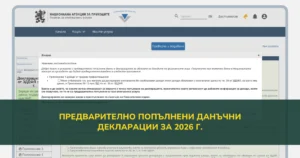
Electronic filing is convenient because the system can automatically populate income data from employment, honoraria, rent, sales, subsidies, and other sources, given a PIK or QES. Users can review, correct, and supplement the information before submission.
What Happens If You Do Not File a Tax Declaration?
Failing to comply with Article 50 may lead to significant penalties. According to the Tax and Social Security Procedure Code (TSSPC):
- If a person does not file the declaration, files it late, or provides incorrect information, they may be fined between 500 and 3,000 BGN, with repeated violations resulting in fines from 1,000 to 6,000 BGN.
- If a required annex is missing or false information is provided, fines range from 100 to 1,000 BGN, with repeated violations from 200 to 2,000 BGN.
These penalties can include both monetary fines and administrative responsibilities, and in severe cases, enforced collection.
Statute of Limitations for Unfiled Tax Declaration
According to the TSSPC and the Public Receivables Regulation, public claims, including tax liabilities, expire after a 5-year limitation period, which begins on January 1 of the year following the year in which the tax should have been paid.
There is also an absolute 10-year limitation, after which the NRA cannot enforce collection, unless the obligation has been deferred or rescheduled. For exact information, it is best to consult the NRA website and the TSSPC.
Recommendation: Use Licensed Accounting Services
The tax process involves numerous legal changes, technical filing requirements, the need for accurate documentation, and attention to deadlines. Licensed accountants have the expertise to maintain accurate data, submit information on time, file electronically, and correctly present the declaration. They reduce the risk of penalties and can advise on tax benefits, including 5% early filing discounts according to the PITA.
By using professional accounting services, you gain peace of mind, save time, and avoid potential fines.
Official Forms and Templates
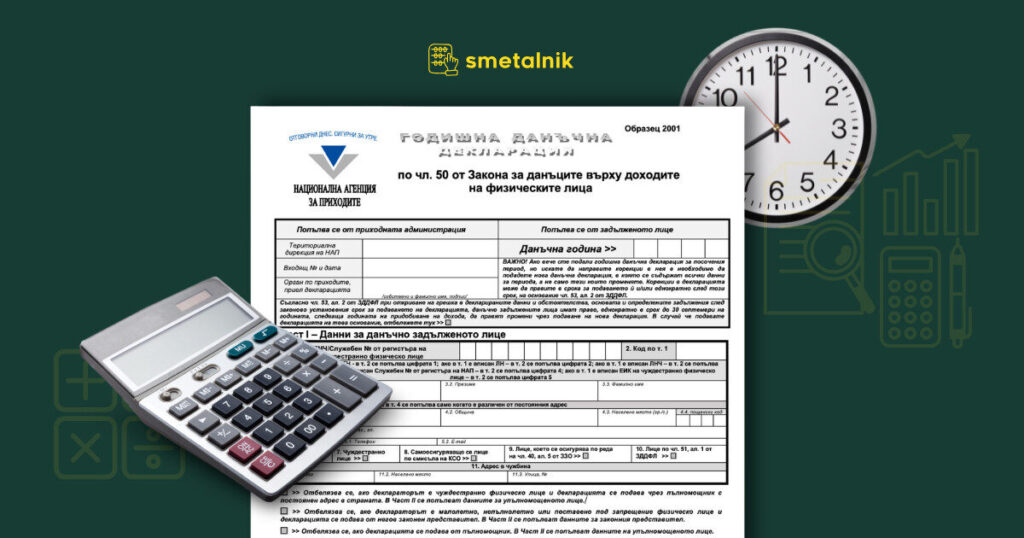
The annual tax declaration form (Article 50 PITA) is publicly available and can be completed via the NRA’s e-services portal, allowing automatic pre-filled data. The portal also provides the necessary annexes and printable forms (paper/barcode) for submission.
Filing an annual tax declaration is a vital part of tax compliance for individuals in Bulgaria. The obligation can arise for self-employed individuals, entrepreneurs, and employees with additional income or specific financial circumstances. Observing deadlines, accurately reporting all income, and using licensed accounting services reduces the risk of errors and penalties. By utilizing professional accounting services, you can avoid fines and complications while ensuring peace of mind and accuracy in your tax obligations.